

The creation of a pair of premium eyewear is a journey that marries ancient material science with cutting-edge precision engineering. It is a narrative defined not by the assembly of parts, but by a series of transformative processes that elevate raw materials into objects of durability, comfort, and optical perfection. This journey, from the vibrant slab of material to the impeccably clean final product, hinges on several critical, often underappreciated, stages. Central to this narrative are five pivotal processes: the foundational art of Cellulose Acetate Sheet Production, the environmentally imperative stage of Wastewater Treatment, the deep-cleansing power of Ultrasonic Cleaning, the delicate final touch of Precision Lens Cleaning, and the seamless orchestration of the Cleaning Line. Together, they form the backbone of quality, sustainability, and performance in modern eyewear manufacturing.
Part 1: The Genesis of Color and Form – Cellulose Acetate Sheet Production
The story of a premium acetate frame begins not on the factory floor, but in the chemical alchemy that creates its very substance. Cellulose Acetate Sheet Production is the cornerstone of quality for what is often called "ziylonite" or simply "acetate." This is not mere plastic injection; it is a labor-intensive, artistic process that yields a material with unparalleled aesthetic and physical properties.
The process starts with natural polymers. Cellulose, derived from cotton linters or wood pulp, is reacted with acetic anhydride to form cellulose acetate flakes. These flakes are then mixed with plasticizers (often non-toxic, plant-based ones in high-end production) and meticulously formulated color pigments or glitter particles. This mixture is heated and kneaded into a viscous dough. The true magic happens during lamination. Colored doughs are layered, folded, and pressed into large blocks under intense heat and pressure. This lamination is what creates the iconic, deep, three-dimensional patterns—tortoiseshell, marble, pearl, and gradient effects—that cannot be replicated by surface painting.
Once cured, these massive blocks are sliced into thin sheets of precise thickness. These sheets are the raw canvas for frame makers. The quality of this Cellulose Acetate Sheet Productiondictates everything: the frame's color fastness (resistance to fading), its flexibility and strength, its hypoallergenic nature, and its ability to be polished to a warm, luminous shine. A premium sheet ensures the material will respond predictably to subsequent CNC milling, hand filing, and heat adjustment, making it the non-negotiable first step in crafting frames of integrity and beauty. Any compromise here reverberates through every subsequent stage of production.
Part 2: The Environmental Imperative – Wastewater Treatment in Eyewear Manufacturing
The transformation of raw materials into finished goods is rarely without environmental impact, particularly in processes involving plating, painting, and chemical cleaning. This makes a robust Wastewater Treatment system not just a regulatory necessity, but a fundamental pillar of responsible and sustainable manufacturing. For a premium brand, a transparent and effective wastewater management protocol is a critical component of its ESG (Environmental, Social, and Governance) commitment.
In an eyewear factory, wastewater is generated from multiple sources: rinsing stages after electroplating (carrying traces of metals like nickel, copper, and chromium), cleaning solutions from Ultrasonic Cleaning tanks, and general industrial runoff. An advanced Wastewater Treatmentfacility employs a multi-stage process. First, physical separation removes suspended solids. Then, chemical treatments—such as pH adjustment and precipitation—are used to force dissolved metals and contaminants to form solids that can be filtered out. Biological treatment may follow to break down organic compounds. Finally, the treated water is often subjected to reverse osmosis or other tertiary treatments to achieve a purity level that allows for safe discharge or, ideally, recycling back into non-critical parts of the manufacturing process.
Investing in such a system mitigates environmental harm, ensures compliance with stringent international standards (crucial for export), and significantly reduces freshwater consumption through recycling. It reflects a holistic view of quality—one that encompasses the product's lifecycle impact. A brand that partners with manufacturers possessing certified Wastewater Treatment capabilities is investing in long-term sustainability and ethical production.
Part 3: The Deep Clean – The Science of Ultrasonic Cleaning
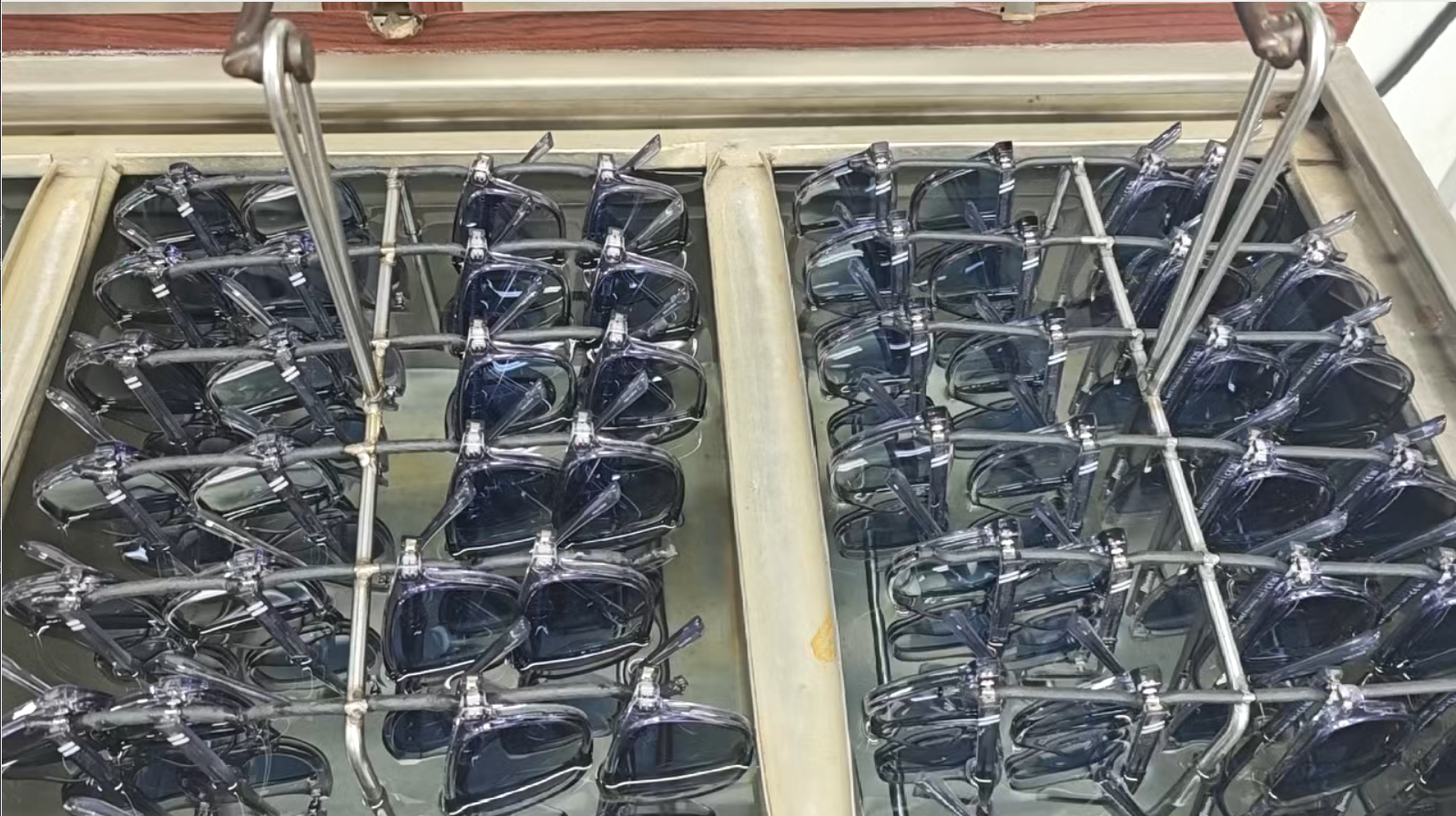
After frames are assembled—having been milled, polished, hinged, and handled—they are inevitably coated with microscopic contaminants: polishing compounds, metal dust from hinges, oils from human hands, and general workshop debris. This is where Ultrasonic Cleaning performs its essential, unseen magic. It is the definitive process for achieving a surgically clean substrate, which is mandatory before final inspection and packaging.
An Ultrasonic Cleaning system consists of a tank filled with a specially formulated, often biodegradable, cleaning solution. Underneath, piezoelectric transducers convert high-frequency electrical energy into mechanical vibrations. These vibrations create millions of microscopic vacuum bubbles in the liquid—a process called cavitation. These bubbles form and implode with tremendous energy at the surface of the submerged eyewear. This intense, micro-scrubbing action penetrates every crevice, blind hole, and the intricate mechanism of spring hinges, dislodging contaminants that manual washing cannot touch.
The efficacy of Ultrasonic Cleaning is governed by key parameters: frequency (lower frequencies create larger, more forceful bubbles for heavy soil; higher frequencies are gentler for delicate parts), temperature, and the chemistry of the cleaning solution. For acetate frames, a neutral pH solution is used to avoid damaging the material's luster. For metal components, a mild degreasing agent may be employed. This process ensures that the frame is not just superficially clean, but fundamentally free of particulates that could later cause wear on hinges or interfere with lens fitting. It is the indispensable prelude to all final finishing steps.
Part 4: The Final Touch – The Art of Precision Lens Cleaning
If Ultrasonic Cleaning prepares the stage, Precision Lens Cleaning is the spotlight performance that delivers optical perfection. This process is dedicated to the coated lenses—be they anti-reflective (AR), blue-light filtering, or photochromic—which are exceptionally sensitive to improper handling. The goal is streak-free, spotless, and optically clear surfaces without compromising the delicate nano-coatings.
Precision Lens Cleaning is a controlled, multi-step ritual performed in a clean, low-dust environment. It begins with an initial rinse using demineralized or deionized water—the absolute key to preventing mineral deposits that cause water spots. A specialized, coating-safe cleaning solution is then applied via fine mist sprayers. This solution is formulated to dissolve oils and smudges without alcohol or ammonia, which can degrade lens coatings and frame finishes.
The critical action is the wipe. Automated or manual, it employs continuous rolls of pristine, non-woven lint-free cloths. The wiping mechanism uses a gentle, non-abrasive contact in a consistent pattern to remove all solution and residue. In high-tech lines, this is followed by a jet-air drying system that uses filtered air to eliminate any lingering moisture. The final step is often a verification under bright, focused light, where inspectors look for any remaining dust, fibers, or micro-scratches. This meticulous Precision Lens Cleaning ensures that the customer's first view through their new glasses is one of flawless clarity, fulfilling the fundamental promise of the product.
Part 5: Orchestrating Purity – The Integrated Cleaning Line
Individually, these processes are powerful; integrated into a coherent Cleaning Line, they become a symphony of efficiency and quality assurance. A modern, automated Cleaning Line is the physical manifestation of the manufacturing philosophy, designed to move frames and lenses through the cleaning stages with minimal human contact, thereby reducing contamination and increasing consistency.
A typical integrated Cleaning Line might begin with a loading station where assembled frames are placed on custom fixtures or carriers. They first travel through the Ultrasonic Cleaning bath, followed by a series of cascading rinse tanks with progressively purer water (often culminating in deionized water). A high-efficiency forced-air drying tunnel removes bulk moisture. The line then converges with the lens station: fitted lenses, having undergone their own Precision Lens Cleaningoffline, are inserted into the clean frames. The complete pair may then pass through a final, gentle steam or fine-spray cleaning cycle to remove any handling dust from assembly, followed by a final blow-off and drying chamber.
The entire Cleaning Line is controlled by programmable logic, with timed immersions, specific temperature zones, and continuous filtration of the cleaning solutions. Its design incorporates easy access for maintenance and monitoring of key parameters like water resistivity and solution concentration. This seamless flow from deep cleaning to final polish ensures every single unit leaving the line meets the same uncompromising standard of hygiene and presentation, ready for final inspection and premium packaging.
Conclusion: The Unseen Pillars of Value
In conclusion, the journey from a slab of cellulose acetate to a pair of clear-vision glasses is underpinned by these five technical pillars. Cellulose Acetate Sheet Production provides the soul of the frame—its color and character. Wastewater Treatment embodies the conscience of the modern factory—its responsibility. Ultrasonic Cleaning offers the foundational purity—the deep cleanse. Precision Lens Cleaning delivers the core promise—optical perfection. And the Cleaning Line represents the intelligent synthesis—the guarantee of scalable, repeatable quality.
For brands, investors, and discerning customers, understanding these processes provides a critical lens through which to assess true value. It reveals that the worth of eyewear lies not just in its design, but in the depth of its engineering and the integrity of its manufacture—a symphony of science and care, performed long before the glasses ever meet the light of day.